Category: Studies
-
Between the Berlaymont and the Glass Palace: The Relative Roles of the EU and NATO in European Defence
Europe’s defence landscape is complex, and the relationship between the European Union and NATO is a prime example. Though only five kilometres apart in Brussels, the EU and NATO often appear worlds apart in practice. This new HCSS report by Davis Ellison and Daniel Fiott offers a clear-eyed assessment of this relationship and a roadmap for improvement. …
-
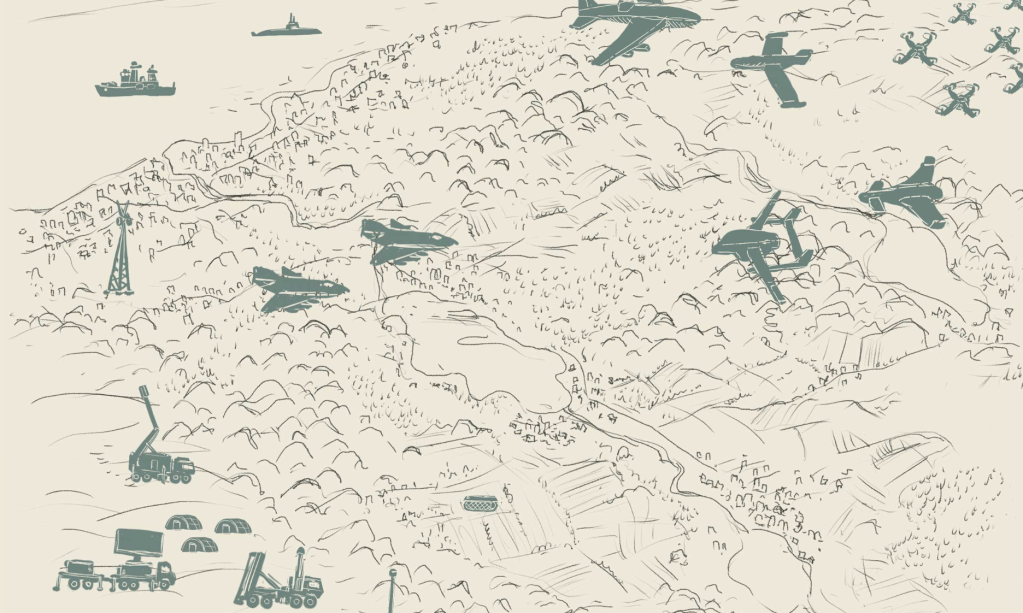
Controlled Adaptation and Integration: Defence AI in Belgium
Belgium’s engagement with artificial intelligence (AI) in defence is best understood not as a dramatic technological leap, but as a series of pragmatic, institutionally embedded steps shaped by alliance politics, budgetary realism and an enduring preference for multinational solutions. Rather than positioning itself as an AI front-runner, Belgium has sought…
-
European Defence Projects of Common Interest: From Concept to Practice
The development of European Defence Projects of Common Interest (EDPCIs) represents a decisive step towards strengthening the EU’s crisis response, economic competitiveness and strategic autonomy. EDPCIs aim to overcome fragmented national defence efforts by promoting joint development, production and procurement of key military capabilities, enhancing the EU’s governance structure for…
-
Assessing Europe’s Resilience and Preparedness in an Era of Strategic Risks
Europe’s security environment is increasingly shaped by “whole-of-society” shocks in which military threats intersect with climatic, economic and technological disruptions. This new reality demands that preparedness and resilience be treated as mutually reinforcing strategic imperatives for both the EU and NATO. Yet Europe’s baseline levels of resilience remain highly uneven.…
-

Ties That Truly Bind? The Potential for Defence Industrial Cooperation between South Korea, NATO and the European Union
Europe and South Korea are increasingly aligned in their pursuit of stronger defence industrial resilience amid intensifying geopolitical competition and technological disruption. Both actors recognise that defence production is now as much about economic sovereignty and technological leadership as it is about security. Europe and South Korea stand to benefit…
-

Counting on the Cloud? NATO, Digital Modernisation and Cloud Computing
NATO is enhancing its defence and deterrence in the face of grave geopolitical risks. While the major focus in 2025 is on ramping up the manufacturing of ammunition, missiles, tanks, armoured vehicles and more, there is a risk that the digital elements of the Alliance’s security and defence are marginalised…
-

Hanging Together or Hanging Separately? Europe and the Indo-Pacific in United States-China Rivalry
The United States appears to be consistent on the idea that “great power” or “strategic” competition and, more specifically, “competition with China” stands out as its overriding national security priority. Insofar as Trump administration’s strategic approach towards Ukraine and Europe appears to be significantly informed by China and Indo Pacific-related…
-

Primed for Deterrence? NATO and the Indo-Pacific in the Age of Great Power Competition
As the United States prioritises deterrence of China in the Indo-Pacific, the question of how Europeans can take primary responsibility for conventional defence in Europe will take centre stage at NATO’s upcoming 76th Summit in The Hague. Against this backdrop, the future of the Alliance’s own Indo-Pacific agenda hinges on…
-

Wait and See? The Dynamics of Europe’s Evolving Approach to the Sahel
13/2024 Having faced a series of coup d’états in recent years, the Sahel region is marked by instability and it raises fundamental security questions for Europe. In a context where European governments are responding to Russia’s war on Ukraine, and where crisis management is viewed with less salience, the Sahel…
-
EU Defence after Versailles: An Agenda for the Future
This analysis focuses on developments in European Union (EU) security and defence since the Versailles Summit, held on 10–11 March 2022. It shows how the Union’s response to Russia’s war on Ukraine has unleashed and spurred on a range of operational, industrial and political initiatives that will influence security and…
-

Qualified Majority Voting in EU Foreign Policy: A Cost of Non-Europe Report
The following study deals with qualified majority voting (QMV) and the common foreign and security policy (CFSP) of the European Union (EU). As the EU develops into a geopolitical actor, it is necessary to analyse its existing and future foreign policy decision-making procedures. However, a series of high-profile instances have…
-

Two Fronts, One Goal: Euro-Atlantic Security in the Indo-Pacific Age
This paper outlines how Europe can contribute to alleviating the “two-front” predicament in U .S. global strategy . It shows how Europeans can help free up the United States’ strategic bandwidth in Europe so as to enable a proper U .S. prioritization of China without weakening Europe’s deterrence architecture. The…
-

Navigating the Euro-Atlantic Defence Innovation Landscape
This report set out to analyse emerging transatlantic defence innovation systems and the extent to which EU and NATO efforts in the domain overlap, are in conflict or have potential synergies. The overarching finding is that EU and NATO systems are separate but heavily interdependent. They are separate in terms…
-

Centre of Gravity: Security and Defence in the Indo-Pacific – What Role for the European Union?
The Indo-Pacific region has emerged as the centre of gravity of global military competition, economic growth, and technological innovation. Whatever happens in the Indo-Pacific is likely to have a pervasive impact on the structure and future of international order, and the norms and institutions Europeans hold so dear. Moreover, as…
-

The Strategic Compass and EU Space-based Defence Capabilities
The European Union relies on space for its economic sovereignty and security and defence. Without space-based capabilities, the EU could not enjoy any degree of strategic autonomy in security and defence. Since the adoption and endorsement of the Strategic Compass, space has only increased its relevance for the EU in…
-

Digitalization and Hybrid Threats: Assessing the Vulnerabilities for European Security
From artificial intelligence to quantum computing, emerging and disruptive technologies (EDTs) may be part of the next revolution in military affairs – but it is not clear how EDTs will shape the future of conflict or strategies aimed at countering hybrid threats. This Hybrid CoE Paper seeks to uncover what…
-

Strategic Compass: New Bearings for EU Security and Defence?
Abstract Over the past twenty years the European Union has enhanced its role as a security and defence actor. However, in a rapidly changing geopolitical environment, the Union faces new threats and security challenges and this calls for a unified, robust and far-reaching approach from the bloc and its Member…
-

European Sovereignty: Strategy and Interdependence
Abstract The notion of European ‘strategic sovereignty’ is increasingly important to debates about the European Union. Given rapidly shifting global geopolitical and technology trends, and the seeming fragmentation of the multilateral order, the EU is being forced to confront its own position in international affairs. A number of concepts have…
-
The European Space Sector as an Enabler of EU Strategic Autonomy
Today, the European Union can boast a degree of strategic autonomy in space. Projects such as Galileo have not only enhanced the EU’s economy, but they may confer on the Union the ability to amplify its Common Foreign and Security Policy and Common Security and Defence Policy. While the EU…
-
Strategic Investment: Making Geopolitical Sense of the EU’s Defence-Industrial Policy
Abstract This Chaillot Paper focuses on new EU initiatives in the defence domain – in particular the creation of the European Defence Fund – and on the Union’s evolving role and engagement in this sector. The paper seeks to address three specific questions: (i) how can economic and political factors be balanced…
-

Protecting Europe: The EU’s Response to Hybrid Threats
Abstract Hybrid threats – unconventional threats that fall under the threshold of military force – have become a ubiquitous feature of today’s security environment. Although the EU is much better placed to detect and combat hybrid threats today than was the case five years ago, this new form of asymmetric…
-
The Scrutiny of the European Defence Fund by the European Parliament and National Parliaments
Since 2016, the European Union has developed a number of new initiatives on security and defence. In particular, the introduction of Permanent Structured Cooperation and the European Defence Fund have been designed to allow the EU to become a more autonomous actor with regard to crisis management, capacity building and…
-
European Armaments Standardisation
The standardisation of armaments has been a long-standing focus of EU efforts to enhance the Union’s military effectiveness, to improve capability development and to support the competitiveness of the European defence industry. Armaments standardisation is a process that can lead to cost savings for defence spending by injecting added-value in…
-
Permanent Structured Cooperation: What’s in a Name?
Abstract Permanent Structured Cooperation (PeSCo), the so-called ‘sleeping beauty’ of EU defence, is awake. Still barely predictable only a year ago, PeSCo is an ambitious, binding and inclusive legal framework aimed at incentivising defence cooperation among member states. PeSCo is based on binding commitments between member states that could promote…
-

Supporting European Security and Defence with Existing EU Measures and Procedures
Focusing on the support of non-CSDP policies for CSDP measures, both in the field of crisis management and defence, this study submits that CSDP cannot effectively contribute to EU external action by itself, but only in coherence with other EU policies and instruments. The study focuses on nine different issue…
 Daniel Fiott