-
Defence: From Strategic Dependence to European Military Autonomy?
Given that Europeans do not get to vote in US federal elections, and European governments are having less and less influence over the direction of strategy in Washington, they need to reset their strategic mentality. Along with the long-standing military dependency on the US has come, for many Europeans, an intellectual dependency on Washington. The cost of Europe’s outsourcing of its defence to America, apart from the industrial damage it has caused, is a laziness and cautiousness in strategic affairs. Those US officials and commentators who are tired of Europe’s dependency are right, even if they find the prospect of losing defence contracts to European competitors worrying. It will take time for Europeans to develop their own strategic awareness, but the early signs are that Europe is heading in this direction. There are grounds for optimism, with defence industries boosting manufacturing, more capabilities filling military inventories and defence investment at a new high.
This article is part of the project launched by the Observatoire Europe, whose director is Bruno Dupré.
DiploWeb: La revue géopolitique
-
“Metro Map” of EU Security and Defence 2026
I am pleased to share the updated “Metro Map” for EU Security and Defence. First created in 2021, I have been really happy to see the original metro map being used in classrooms and training sessions. I certainly did not suspect it would be so useful. In any case, the EU is constantly evolving, and it is time for an update (not least because many have asked me for an update). This 2026 edition is slightly different. First, I have tried to make the design simpler (so less a “piece of art” 🙂 and more an educational tool). I am sure I have made a few errors, and some will dispute the connections of some policies. Not every policy or initiative has been included due to space and design constraints. Second, I have expanded the number of “stops” to include a few EU initiatives on economic security and democratic resilience, which are essential parts of European security. Finally, I have included strategic domains such as space, cyber and maritime security as separate metro stop clusters. I hope it is of use!
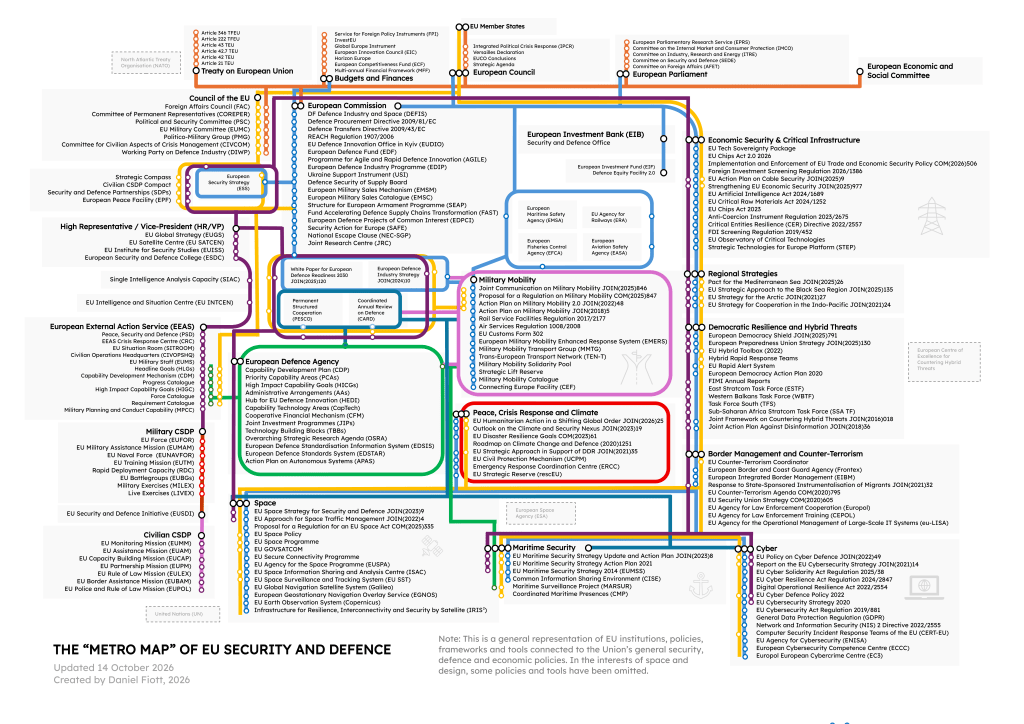
Here is the PDF to download and use freely (with credit please!)
-
Institutionalising Defence Production: Reconceptualising the Role of Institutions and States in European Defence Industrial Policy
This article analyses how questions about European defence production efforts have been institutionalised at the European Union level, and it does so by drawing on the academic literature on the interplay between intergovernmentalism and supranationalism in the domain of EU defence industrial policy. The creation of financial tools such as the Security Action for Europe and the European Defence Industrial Programme has only sharpened the focus on the role of institutions such as the European Commission and the strategies of member states. Looking specifically at initiatives such as the EDIP, SAFE and the revised SGP rules for defence, this article assesses the relationship between the European Commission and member states through the theoretical lenses of supranationalism and intergovernmentalism. The article looks at how EU funding schemes and regulations uncover how the Commission and member states balance concerns about national sovereignty, economic competitiveness and European integration.
European Security
-
European Defence and Statecraft in 2050: And What Needs to be Done to Get There
What would European defence look like if NATO were to disband or become ineffective? In the latest paper in CEPR’s Europe 2050 series, Daniel Fiott (Vrije Universiteit Brussel) treats this as a serious thought experiment rather than a remote contingency. His starting point is that the EU, in its current form, is not an obvious substitute for NATO: it lacks integrated command structures, strategic leadership, military capabilities and a nuclear deterrent, and excludes key military powers such as the UK and Türkiye. A “Europeanised NATO” without the US would face equally formidable political challenges, since no single European state possesses the military weight or political legitimacy to replace American leadership. Fiott’s central argument is that the answer lies in an underused and underappreciated instrument already embedded in EU law: Article 42(7) TEU, the Mutual Defence Clause. Rather than a symbolic commitment invoked once, by France in 2015, it is a binding obligation capable of serving as the legal foundation for a genuine European collective defence system, provided it is given the institutional substance it currently lacks: common defence planning, capability targets, contingency plans, command arrangements and a force generation process. None of this requires treaty revision. What it requires is an avant-garde of willing member states prepared to begin that planning work within the existing EU legal order, treating the Clause not as a reactive fallback but as the organising principle of European defence to 2050.
Centre for Economic Policy Research
-
Advancing the Inclusion of SMEs in the European Defence Technological and Industrial Base
Against the backdrop of Russia’s war against Ukraine, and the rapid battlefield adaptation that it has led to, defence innovation and small and medium-sized enterprises (SMEs) are being seen as key contributors to Europe’s industrial preparedness, production scalability and security of supply. To this end, recent European Union (EU) policy and financial initiatives have specifically targeted SMEs in the defence sector, to address the financial, regulatory and industrial bottlenecks facing SMEs in Europe. However, SMEs still face considerable challenges and barriers. This Study examines the evolving role of SMEs within the European Defence Technological and Industrial Base (EDTIB). It specifically analyses the persistent barriers preventing SMEs from entering the defence market in Europe, and, once present, from scaling their innovation, services and products. The Study argues that, despite the growing political recognition of SMEs as sources of technological and disruptive innovation, SMEs still face considerable financial, regulatory and political barriers to access the EDTIB.
European Parliament study, 2026
-
The Strategy Trap? European Threat Assessments and the Problem of Common Action
The EU’s 2026 threat assessment demonstrates that while Europe has developed a clearer understanding of its strategic environment, it remains less certain about the political choices required to respond to it. Russia’s war has brought European threat perceptions closer together, but convergence around the existence of a threat has yet to produce a genuinely common European strategic outlook. While Europeans increasingly agree on the threats they will face by 2030, they remain far less confident in their collective ability to respond to them.
CSDS Policy Brief, 17/2026
-
Russia’s War on Ukraine: A Zeitenwende for European Defence?
Russia’s full-scale invasion of Ukraine in 2022 profoundly transformed Europe’s strategic landscape, forcing governments across the continent to rethink the foundations of their defence policies. But did the war truly result in a European “Zeitenwende”? This volume provides the first comprehensive analysis of how European countries, the EU, and NATO responded to the largest security shock in Europe since the Cold War. Written by leading experts, the chapters offer empirically grounded analyses of how the war reshaped defence objectives, military procurement, and political debates across Europe.

The book shows that the war triggered far-reaching changes in threat perceptions, objectives, and military capabilities. Still, significant differences remain in how European states perceive the Russian threat, how rapidly they invest in defence, and how far they are willing and able to adapt. Europe’s security will ultimately depend on whether European states can cooperate effectively despite persistent national differences, a major challenge that will shape the future of the continent.
My own chapter contribution focuses on how the European Union have adjusted to the war on Ukraine. A big thank you to the excellent editors of the book: Tim Haesebrouck, Michelle Haas and Servaas Taghon.
Palgrave Macmillan, September 2026
-
Ankara and NATO 3.0: A Time of Reckoning?
NATO leaders will meet once again in Ankara on 7-8 July 2026. This will be the second summit ever held in Türkiye, with the first held in Istanbul in 2004. Back then, allies were celebrating the enlargement of NATO to include seven new allies, mostly from the Eastern Flank countries. The Summit also expanded the NATO-led operation in Afghanistan and reinforced the alliance’s presence in the Western Balkans and Mediterranean. The 2026 Ankara Summit, by contrast, will have three main formal agenda points: 1) increasing defence investment in line with The Hague Summit goal of 5% of GDP; 2) strengthening NATO’s defence industry; and 3) supporting Ukraine. On all three points, NATO can boast some success as allies are demonstrably increasing defence investment and, as a result, their defence industries are being spurred into action with increased defence production. Even on Ukraine, allies will meet in Ankara with the relatively positive news that Ukraine is making significant military advances over Russia – and quite literally over Russia, when one considers all of the impressive drone strikes on Russian defence and energy infrastructure.
Italian Institute for International Political Studies, July 2026.
-
Wanted: European Defence Sector Talent
High-end talent and skills have emerged as a decisive factor in Europe’s ability to convert greater spending into defence capabilities. Without a sufficient talent pool, the defence industrial base risks becoming a bottleneck rather than an enabler of security. The scale of the challenge is already visible. ASD Europe calculates that the European defence industry employs roughly 581,000 people, yet demand for labour has surged sharply since 2022, with job postings remaining over 40% higher than pre-war levels.
Firms in Europe report persistent difficulties in recruiting engineers, technicians and digital specialists, even as governments pledge hundreds of billions in additional defence spending. The European Commission openly recognises skills shortages as a structural constraint, warning that gaps in the labour market threaten Europe’s security. Eurostat indicates that the median age of the workforce in hightech manufacturing in Europe is about 42 to 44 years of age, so it is imperative that younger talent pools are tapped for the defence sector in the years ahead.
The challenge is not just about numbers.Defence increasingly depends on advanced AI skills that are also in high demand in civilian sectors, intensifying competition for talent. Years of underinvestment, an ageing workforce and fragmented training systems have further strained the pool of specialised skills. While one estimate states that around 0.41% of Europe’s workforce are AI professionals, Europe continues to train talent in science, technology, engineering, and mathematics subjects (STEM) that it struggles to retain, as they leave Europe.
Patria Group
-
Defence Technology Governance in the European Union
The 2025 EU White Paper on Defence underscores the need for a more risk-tolerant regulatory environment to foster European defence technologies and innovation. As the EU expands its role in defence, it faces complex governance challenges, particularly in managing emerging technologies such as AI, robotics, cyber and biotech. The Union’s sui generis structure—comprising diverse state and non-state actors—complicates efforts to design cohesive regulatory frameworks, especially given the prevalence of dual-use technologies. Legal competencies outlined in EU Treaties further constrain centralised governance, as operational control remains with member states. Nonetheless, instruments like the EU Common Position on arms exports, the Dual-Use Regulation and the European Defence Fund introduce mechanisms for responsible oversight. This chapter examines both existing EU regulations and the political challenges of governing defence technologies amid rising global proliferation and reduced emphasis on governance by major powers like the US and China.
Springer Cham, 2026
-
Subscribe
Subscribed
Have a WordPress.com account? Log in now.

